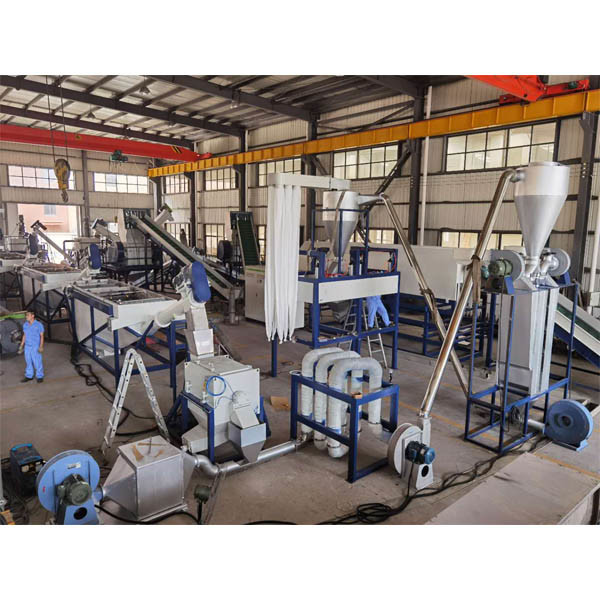
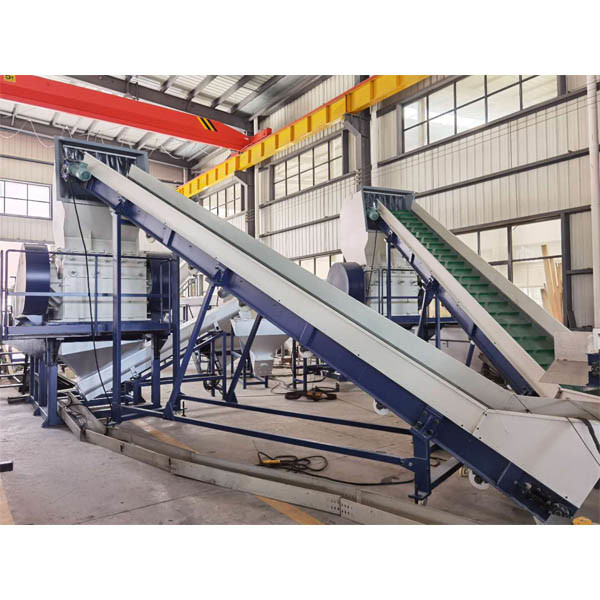
Plastic Washing Recycling Machine Designed for PET Bottle Flakes Production with Complete Separation and Washing Systems
The complete PET bottle flakes washing line has been exported to more than 10 countries.
We have installed machines in:
Romania
Sudan
China
India
Final PET flakes specification:
|
Description of final product
|
1. Moisture: ≤0.9%
2.IV: our line doesn’t change the Intrinsic viscosity
3. Bulk density: 0.3G/CM3
4 Total impurity : ≤50ppm
l Metal content: ≤10ppm
l PE/PP content: ≤7ppm
l Paper: ≤5ppm
l glue/hot melt: ≤7ppm
l organic and in-organic : ≤5ppm
l PVC : ≤30ppm
5. Flakes size: 12-14mm
|
The machine capacity runs from 500-3000kg per hour.
Complete Processing System
Debaling System• Trommel Screen (Size Classification)• Eddy Current & Magnetic Separators• AI Sorting Unit• Crusher• Flotation Tank (Density Separation)• Friction & Hot Wash Systems• Dewatering Unit• Label Separator• Color & Material Sorters (Final QC)• Automated Packing Line
AI Sorting Technology
The AI sorter represents a critical advancement in our washing line technology, delivering significant operational benefits:
- Reduces downstream workload by up to 40%
- Minimizes manual sorting requirements
- Decreases need for final material sorting
- Substantially improves PET flake quality
- Enhances overall product consistency
- Recommend the local China brand or European brand sorting machine.
We collaborate with leading AI technology providers including Meyer, Tomra, and Taihe to continuously improve our line's automation capabilities and output quality.
AI Sorting Technology Working Principle
Our advanced AI bottle color sorting system operates through a sophisticated process:
- High-speed cameras capture detailed visual information of each bottle
- Pre-trained deep learning AI models analyze and evaluate the images
- System identifies discolored bottles, different materials, and various defects
- Non-conforming products are precisely removed via high-pressure air ejection
Core Advantages of AI Bottle Color Sorters
Compared to traditional color sorting technology, our AI-powered systems deliver superior performance:
High Precision and Low Misjudgment Rate
AI models understand complex visual contexts, distinguishing between normal bottle reflections and actual contaminants, dramatically reducing false rejections.
Comprehensive Defect Detection
Performs simultaneous color sorting and defect detection in a single operation.
Continuous Learning Capability
The system collects new data on non-conforming products to continuously refine and improve sorting accuracy over time.
Exceptional Flexibility
Changing sorting criteria requires only AI model or parameter adjustments, eliminating complex optical recalibration.
Except the AI sorting, we also make much improvement on the debale machine.
With four shaft debale machine, the effecient has been improved and quality increased.
Also the Trommel machine is qualified to separate the caps and stones.
Moreover the function of the hot washing is important:
1. Removal of Stubborn Organic Matter and Adhesives
Target Contaminants: Primarily addresses label adhesive (pressure-sensitive adhesive), grease, sugars, residual beverages, etc., that remain on the PET flakes after processes like crushing, friction washing, and cold washing.
Working Principle:Utilizes thermal energy (typically heating the washing medium to 70°C - 95°C) to reduce the viscosity of these organic pollutants, causing them to soften, dissolve, or emulsify, thereby making them easier to detach from the PET flake surfaces.
2. Loosening and Removal of Embedded Labels and Impurities
In hot water, shrink sleeves (e.g., PE film) relax due to the heat, facilitating easier separation from the PET flakes.
Stubborn impurities embedded in cap threads or creases of the bottle body also become easier to wash out under the thermal effect.
3. Enhancement of Flake Whiteness and Luster
Hot washing effectively removes fine stains and oxidation layers adhering to the flake surfaces, significantly improving the visual whiteness and sense of purity of the recycled PET flakes. This is crucial for subsequent use in producing light-colored or transparent products.
4. Improvement of the Final Product's Intrinsic Viscosity (IV)
This is a key chemical function of hot washing. PET is prone to hydrolytic degradation at high temperatures, leading to a decrease in its Intrinsic Viscosity (IV value), which affects performance in spinning or bottle blowing.
The hot wash tank rapidly removes the surface layer of degraded, low-IV PET from the flakes, exposing the higher-quality, higher-IV PET within. This stabilizes and enhances the average IV value of the final rPET pellets.
5. Preparation for the Next Stage: "Friction Washing" or "Float-Sink Separation"
After hot washing and chemical action, contaminants are loosened from the PET surface. Subsequent mechanical action through intensive friction washing, or the use of hot water float-sink separation (where density differences between materials are more pronounced in hot water), then thoroughly separates the dislodged impurities (such as PE/PP cap fragments).

6. Process Synergy (Often Combined with Chemicals)
The hot wash tank typically has specialized cleaning agents (e.g., alkaline solutions) added. The synergistic effect of Heat and Chemistry greatly improves cleaning efficiency, achieving better results in a shorter time.

How to Choose a PET Bottle Washing Line
According to Capacity
- 500kg/h
- 1000kg/h
- 2000kg/h
- 3000kg/h
According to Final Flakes Quality
- Fiber Grade
- Sheet Grade
- Food Grade
According to Contamination Level
- Light contamination
- Heavy contamination